GENERAL INFORMATION
Section 1
GENERAL INFORMATION
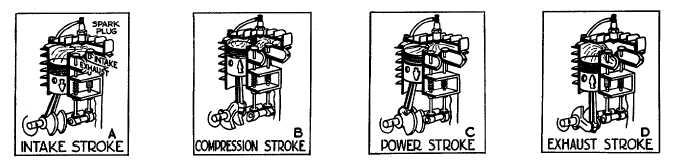
Briggs & Stratton engines are of the same basic 4 stroke cycle design used in automobiles, aircraft trucks and tractors. As
the name indicates, there are four strokes to one complete power cycle:
Fig. 1 - The 4-Stroke Cycle
a.
INTAKE STROKE:
The piston goes down, creating a vacuum in the cylinder which draws gas through
open intake valve into the space above piston.
b.
COMPRESSION STROKE:
The piston comes up with both valves closed, highly compressing the gas into the
space left between the top of the piston and cylinder head.
c.
POWER STROKE:
At this point the magneto sends high tension current to the spark plug, firing or
exploding the compressed gas and driving the piston down.
d.
EXHAUST STROKE:
Exhaust valve opens and the upward stroke of the piston forces out all of the burnt
gases, thus completing the power cycle.
CAUTION
Exhaust gases contain carbon monoxide which is odorless and a deadly poison. Proper care must be taken to provide
efficient ventilation when running an engine indoors.
Fill the crankcase and air cleaner with proper oil before starting engine. See that oil level is maintained.
Do not fill the gasoline tank while the engine is running. Avoid spilling gasoline on a hot engine - This may cause an
explosion and serious injury.
USE CLEAN GASOLINE
We recommend “regular” grade gasoline for all Briggs & Stratton engines. However, the use of lead-free, or low lead,
gasolines will result in reduced combustion deposits and normally will improve engine life. Therefore, lead-free, or low
lead, gasoline may be used, where available.
We also recommend that gasoline be purchased in small quantities, not more than a 30-day supply. FRESH gasoline
minimizes gum deposits, and also insures a fuel with volatility tailored for the season.
NOVEMBER 1976
1
1